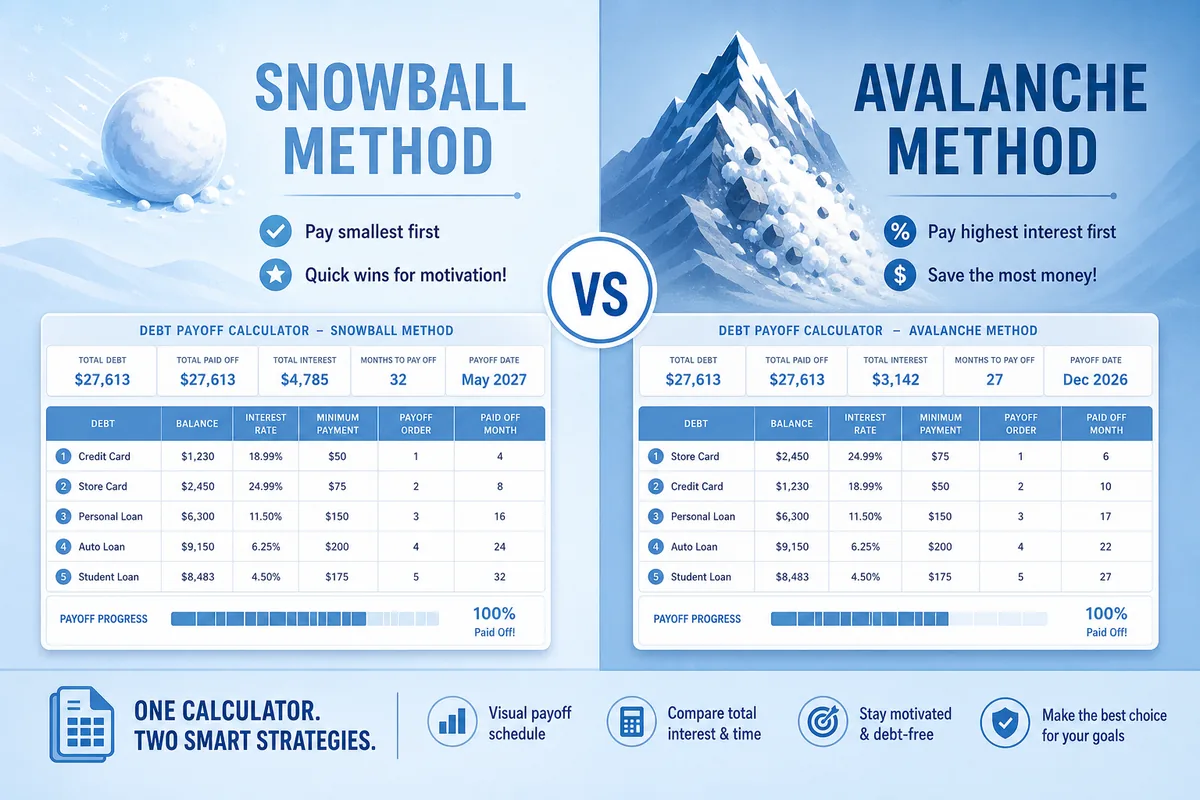
If you're ready to tackle your debt, you've probably heard of two popular strategies: the Debt Snowball and the Debt Avalanche. Both work. Both will get you debt-free. But they take different approaches — and the right one for you depends on how your brain works.
Let's break them down.
The Debt Snowball Method
How it works: Pay minimum payments on all debts, then throw every extra dollar at your smallest balance first. Once that's paid off, roll that payment into the next smallest debt. Repeat until debt-free.
Example:
Say you have three debts:
- Credit Card A: $500 balance, 22% APR
- Credit Card B: $3,000 balance, 18% APR
- Car Loan: $8,000 balance, 6% APR
With the Snowball method, you'd attack them in this order: Credit Card A → Credit Card B → Car Loan.
Pros:
- Quick wins. You'll pay off that first debt fast, which feels amazing.
- Momentum. Each payoff builds motivation to keep going.
- Simplicity. Just look at balances — no math required.
Cons:
- Costs more. You may pay more in total interest.
- Takes longer (sometimes) to be completely debt-free.
"The Snowball method is about behavior change, not math. Quick wins keep you in the game." — Dave Ramsey
The Debt Avalanche Method
How it works: Pay minimum payments on all debts, then throw every extra dollar at your highest interest rate first. Once that's paid off, roll that payment into the next highest rate. Repeat until debt-free.
Example:
Using the same debts:
- Credit Card A: $500 balance, 22% APR ← Start here
- Credit Card B: $3,000 balance, 18% APR
- Car Loan: $8,000 balance, 6% APR
With the Avalanche method, you'd attack them in this order: Credit Card A → Credit Card B → Car Loan. (Same order in this example, but it won't always be!)
Pros:
- Saves money. You'll pay the least total interest.
- Mathematically optimal. This is the "correct" answer.
- Faster payoff (in terms of total interest and sometimes time).
Cons:
- Slower first win. If your highest-rate debt is also large, it takes a while to see progress.
- Requires discipline. You have to trust the math when it doesn't "feel" like progress.
Side-by-Side Comparison
| Factor | Snowball | Avalanche |
|---|---|---|
| Order of payoff | Smallest balance first | Highest interest first |
| Total interest paid | More | Less |
| Psychological benefit | High (quick wins) | Lower (delayed gratification) |
| Best for | Motivation-driven people | Numbers-driven people |
So Which Should You Choose?
Choose Snowball if:
- You need motivation and quick wins
- You've tried to pay off debt before and quit
- Your interest rates are fairly similar
- You value the psychological boost
Choose Avalanche if:
- You're disciplined and can stick to a plan
- You have one debt with a much higher rate than others
- Saving money is your top priority
- You trust the math over feelings
The Truth? Both Work.
The best debt payoff method is the one you'll actually stick with. If the Snowball method keeps you motivated and you pay off all your debt, it's better than an Avalanche plan you abandon after two months.
The most important thing is to pick one and start.
Want to Compare Both Methods for Your Debt?
Our Debt Freedom Calculator shows you both methods side by side — with your actual numbers.
See the CalculatorFinal Thoughts
Whether you choose Snowball or Avalanche, you're making a great decision. You're taking control of your finances and working toward freedom.
Run the numbers, pick your method, and let the bot do the math. You've got this.
— CG Bots